
The method
What is homeopathy?
A system of medicine developed by the German physician Samuel Hahnemann in the 1790s, practised in India for close to two centuries and now one of the systems recognised by the Government of India under the Ministry of AYUSH. It has its own degree courses, statutory councils and practitioner register.

The two ideas it rests on
Like cures like
Similia similibus curentur
A substance that produces a particular set of symptoms in a healthy person is used, in prepared form, for a person showing a similar set. Cutting an onion makes the eyes stream and the nose run; Allium cepa, prepared from onion, is a remedy a homeopath may consider for a cold that behaves that way.
The minimum dose
Potentisation
Remedies are prepared by repeated dilution and vigorous shaking, a process called potentisation. The strength written on a bottle — 30C, 200C — refers to how many times this has been carried out, not to a quantity of substance.
Where it comes from
Two hundred years, and a register to practise on
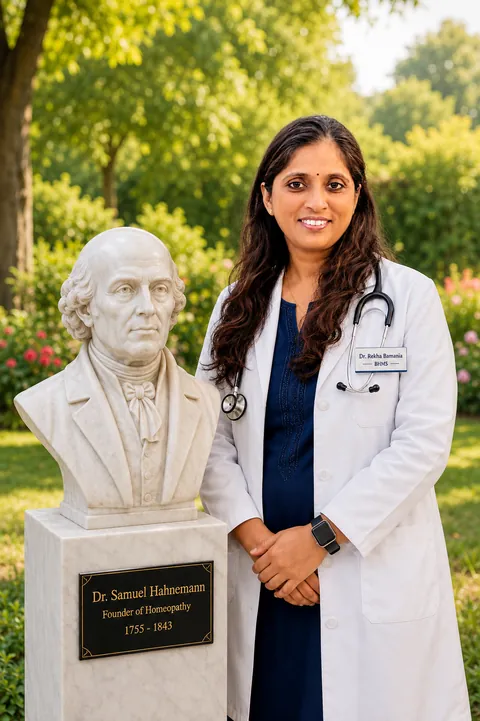
Samuel Hahnemann (1755–1843) was a German physician and translator who set out the method in the 1790s and spent the rest of his life testing and writing it down. Homeopathy reached India in the early 1800s and has been practised here ever since.
What that means today is ordinary and checkable: a five-and-a-half year B.H.M.S. degree, a statutory state council, and a public register of practitioners. Dr. Bamania holds Reg. No. G-8579 with the Council of Homoeopathic System of Medicine, Gujarat State.
Why two people with the same complaint get different remedies
This is the part that surprises people most. A homeopath prescribes for the person, not the label on the complaint. Two patients may both come with a cough — but one is worse at night and better sitting up, the other is worse in a warm room and cannot bear to be spoken to. Those differences are the case, and they lead to different prescriptions.
It is also why the first consultation takes as long as it does. What you eat, how you sleep, what worries you, how you respond to heat and cold — none of it is small talk. It is the material the prescription is built from.
What the remedies are made from
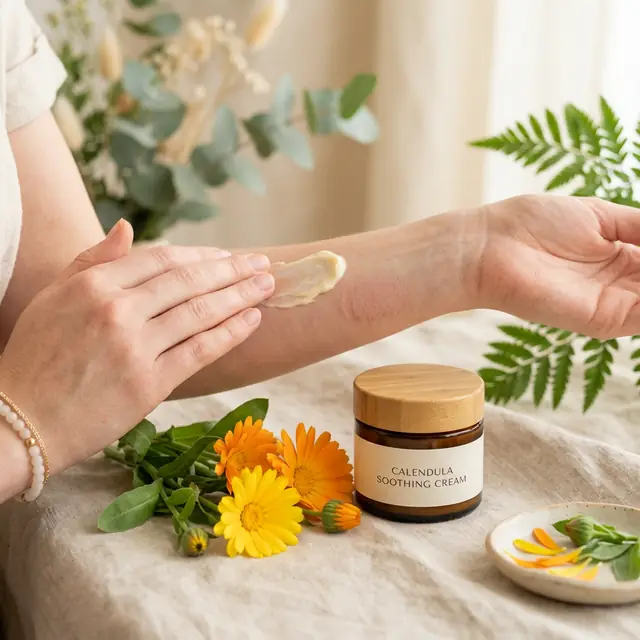
Most come from plants — arnica, belladonna, chamomilla, calendula. Others come from minerals such as sulphur, silica or common salt. They are prepared in licensed pharmacies to the standards of the Homoeopathic Pharmacopoeia of India, and dispensed as small sugar globules, as drops in alcohol, or as a powder.
Alongside other treatment
Many patients at the clinic are also under the care of other doctors, and that is entirely normal. Bring your prescriptions and any recent reports to the consultation. Never stop a medicine another doctor has prescribed without speaking to that doctor first — and if a complaint is severe, sudden or getting rapidly worse, seek immediate medical attention.
Come and talk it through.
Dr. Bamania sees patients at both clinics in Vadodara, in Gujarati, Hindi or English. Call or send a message and you will reach the practice directly.